 Innovation & Cooperation in Naval Architecture & Marine Engineering Association


Helical Rod Ingeniously Converts the Force of a “Bamboo-Copter”: HEU’s Self-Powered Ocean Wave Technology Published in Nano Energy
Harbin Engineering University has thoroughly implemented the guiding principles of the 20th National Congress of the Communist Party of China and the plenary sessions of the 20th CPC Central Committee, and has continuously carried out the important speech and instructions made by General Secretary Xi Jinping during his inspection visit to the university, contributing wisdom and strength to serving high-level scientific and technological self-reliance and self-strengthening.
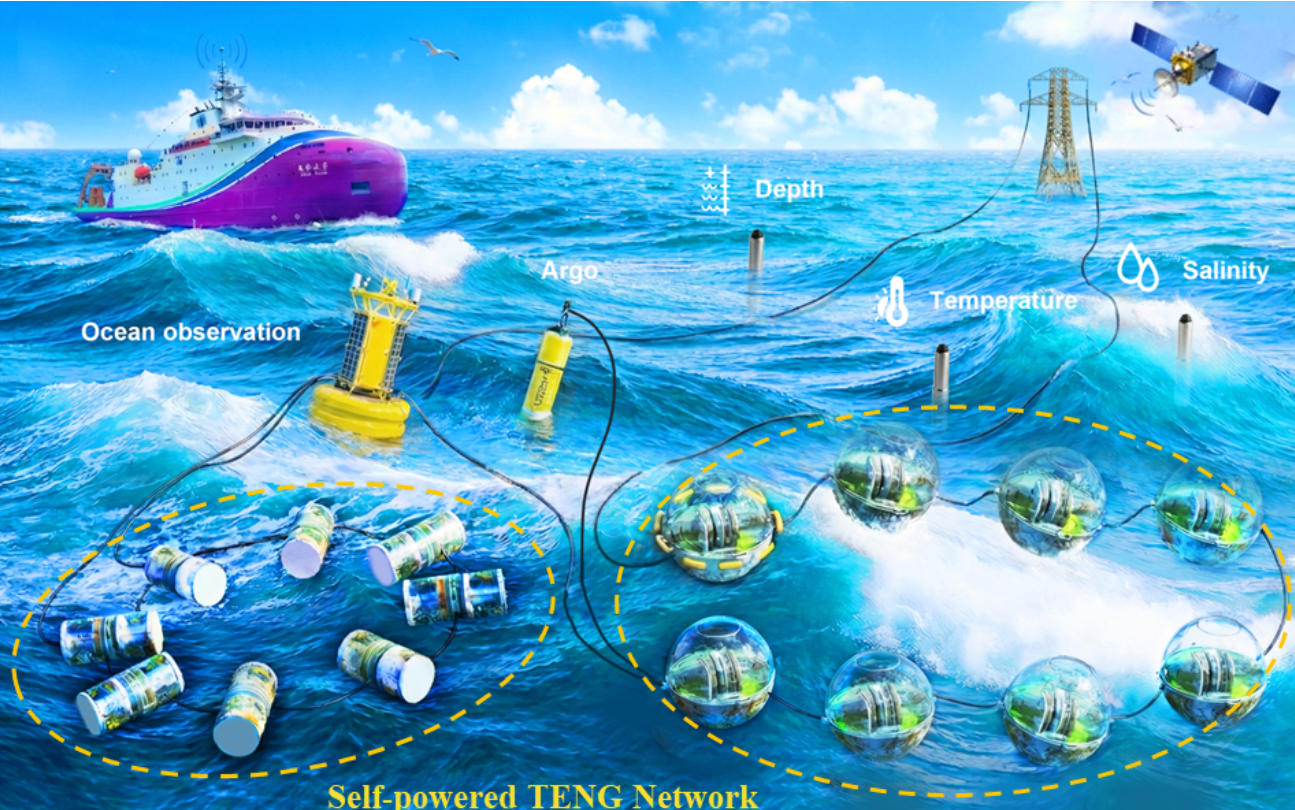
Recently, the “Xinghai” academic team in fluid mechanics at the College of Shipbuilding Engineering achieved an important breakthrough. Its research achievement, titled “Helical-rod-driven cylindrical triboelectric nanogenerator for efficient ultra-low-frequency, low-steepness ocean wave energy harvesting,” was published in Nano Energy, a top journal in the interdisciplinary field of nano energy and functional materials. The first author of the paper is Mao Erjie, a master’s student at the College of Shipbuilding Engineering, Harbin Engineering University, and the corresponding authors include Associate Professor Zhang Jie.
Equipment such as deep-sea and open-ocean buoys and underwater vehicles has long been constrained by problems including short battery life, high operation and maintenance costs, and pollution risks. Insufficient offshore energy self-supply has become a bottleneck restricting the large-scale development of the marine Internet of Things. Real ocean waves are mostly weak excitations with ultra-low frequency and low steepness, making it difficult for conventional triboelectric nanogenerators to be effectively triggered, resulting in weak and intermittent power generation.
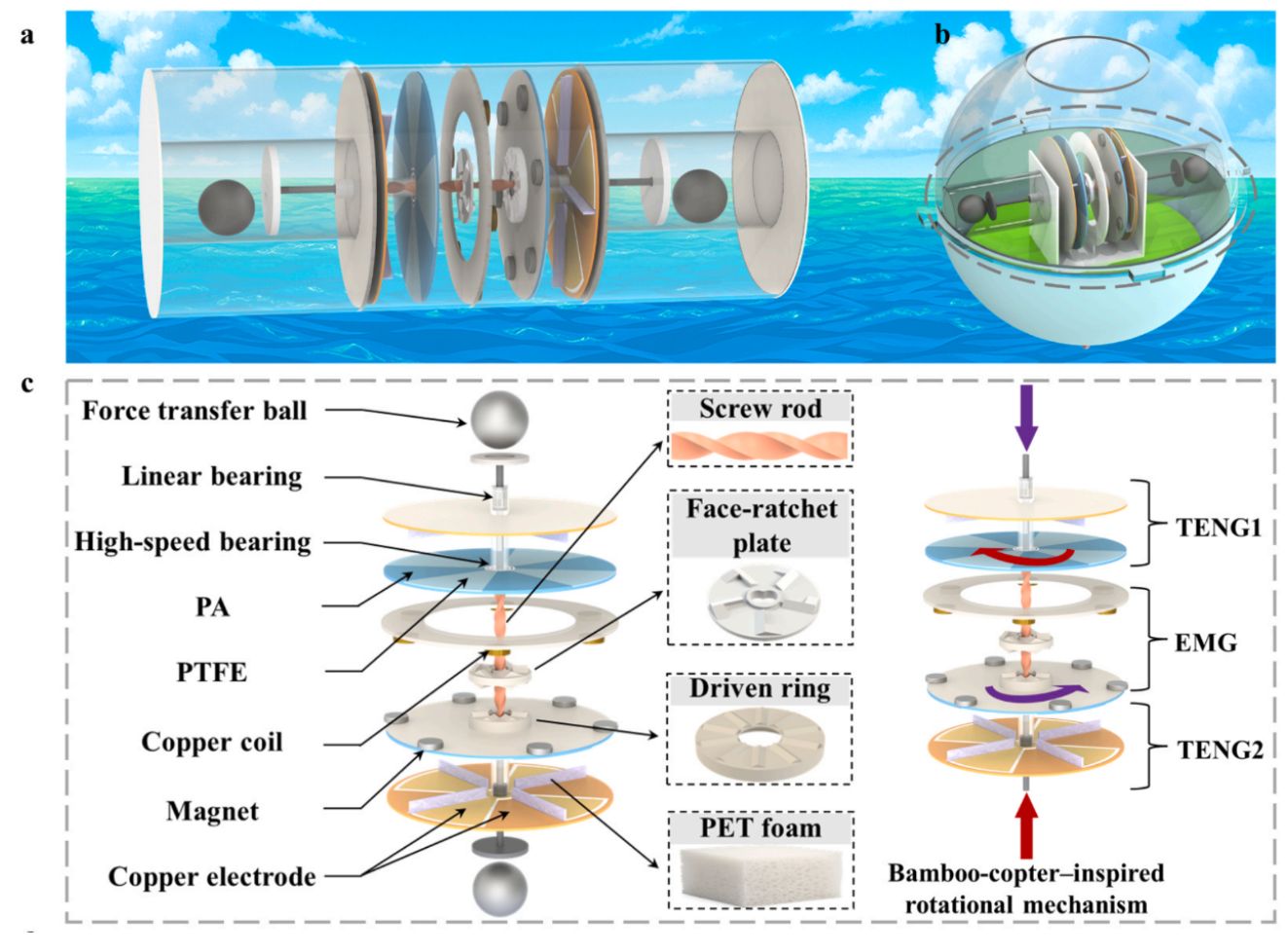
Inspired by the helical lift mechanism of the “bamboo-copter,” the team ingeniously designed a mechanical rectification mechanism consisting of a “helical rod plus an end-face ratchet one-way clutch.” Heavy balls at both ends of the device generate axial reciprocating motion with the rise and fall of ocean waves, which is converted by the helical rod into continuous unidirectional rotation. A single low-frequency excitation can sustain continuous power generation for 12 seconds, fundamentally addressing the challenges of “difficult triggering, weak output, and discontinuity” in power generation under weak sea conditions.
In terms of electrical design, the team adopted a ternary dielectric structure composed of PA, PTFE, and foamed PET, together with a copper electrode system. By utilizing the enhancement effect of porous PET foam, which functions both as a charge pump and a charge transfer medium, the power generation performance was improved by 50%.
Through structural optimization and hybrid interconnection between the triboelectric nanogenerator and electromagnetic generation, the device achieved an open-circuit voltage of 901.54 V, a short-circuit current of 25.05 mA, and a frequency-normalized volumetric power density of 2.84 W/m³/Hz under operating conditions of 0.1 Hz and a 15° inclination angle, outperforming most reported devices of the same type.
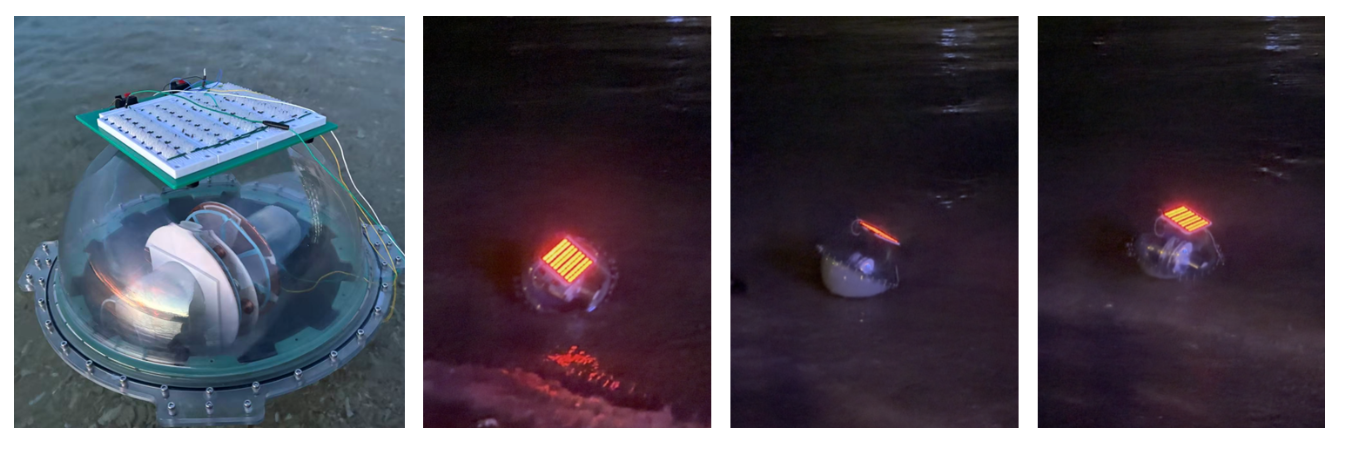
Using a six-degree-of-freedom RAO hydrodynamic model, the team clarified the mechanism of coupled resonance. In tank tests, the device produced an output current of 27.86 mA and a voltage of 839.5 V under a resonance condition of 0.7 Hz, showing strong agreement with the simulation results. In real-sea tests in Sanya Bay, the device successfully lit 532 high-brightness LEDs and stably powered a temperature and humidity monitoring module.
This research established a complete closed loop of “hydrodynamic simulation optimization—small-scale tank physical iteration—real-sea experimental verification.” It transformed the specialized ship performance tank into an open incubation platform for new marine equipment, greatly lowering the threshold for innovative validation.
The technology is expected to be applied in marine environmental monitoring, ecological observation, deep-sea and open-ocean early warning, and low-power sensor networks, providing in-situ energy harvesting and self-sufficient power support for smart ocean systems requiring long-term and stable operation.
Nano Energy is an internationally leading journal in the interdisciplinary field of nano energy and functional materials. It has long focused on frontier areas such as energy conversion, energy harvesting, self-powered systems, flexible electronics, nanogenerators, and intelligent sensing, with an impact factor of 16.8.
Original Link:
https://news.hrbeu.edu.cn/info/1141/88988.htm