
China’s Shipbuilding Industry Advances toward Farther and Deeper Seas
July 11, 2026, marked the 22nd China Maritime Day. As the fundamental carrier and essential tool of maritime activities, ships play a vital role in connecting the world’s oceans. Supported by China’s strong manufacturing base, an increasing number of internationally advanced vessels have been completed and delivered, demonstrating the country’s growing capability to explore and operate across farther and deeper waters.
China further consolidated its position as the world’s leading shipbuilding nation in 2025, maintaining the largest global market share for the 16th consecutive year. During the first quarter of 2026, the country’s shipbuilding output, newly received orders, and orderbook increased year-on-year by 46.0%, 195.2%, and 43.6%, respectively. These indicators accounted for 57.3%, 84.9%, and 69.8% of the corresponding global totals.
Beyond expanding production capacity, China’s shipbuilding industry is accelerating its transition toward high-end, intelligent, and environmentally sustainable development.
1. Progress in High-End Shipbuilding
China has continued to strengthen its ability to design and construct technologically sophisticated vessels. The country’s second domestically built large cruise ship, Adora Flora City, has achieved the comprehensive domestic sourcing of major materials and equipment and is scheduled for delivery in November 2026.
A large cruise ship industrial cluster, centered on ship assembly and construction enterprises and supported by equipment manufacturers and service providers, is also taking shape. Meanwhile, China has achieved batch deliveries in several high-value ship categories, including dual-fuel passenger and roll-on/roll-off vessels, large LNG dual-fuel vehicle carriers, and very large ethane carriers.
These developments reflect the continued improvement of China’s integrated capabilities in ship design, construction management, equipment supply, systems integration, and industrial coordination.
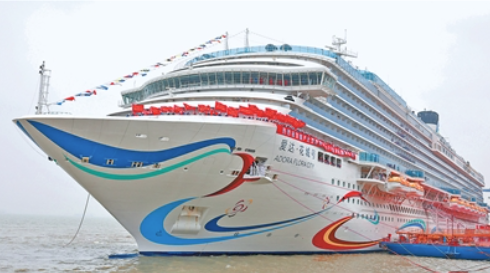
Adora Flora City — China’s Second Domestically Built Large Cruise Ship
Adora Flora City is China’s second domestically built large cruise ship. Its public areas and outdoor recreational spaces cover 25,599 square metres and 14,272 square metres, respectively, and the vessel can accommodate up to 5,232 guests at full capacity. In May 2026, it successfully completed all 149 sea-trial items in a single trial, marking the first time that a domestically built large cruise ship in China passed all sea-trial tests on its first attempt.
The photo shows Adora Flora City berthed at Shanghai Waigaoqiao Shipbuilding after completing its sea trials.
Photo: Fang Zhe/Xinhua
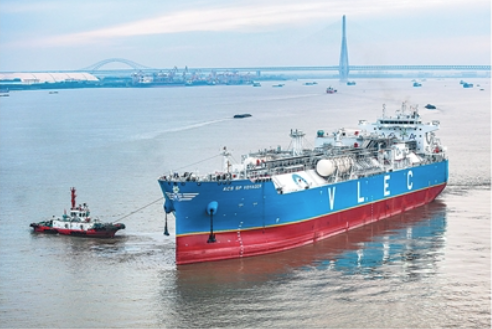
Xin Fu 137 — 100,000-cubic-metre Very Large Ethane Carrier
The 100,000-cubic-metre very large ethane carrier (VLEC) Xin Fu 137 was built by Jiangsu Yangzi Xinfu Shipbuilding Co., Ltd. As one of the world’s largest ethane carriers, the vessel represents another important achievement by China’s privately owned shipbuilders in the construction of high-end specialized vessels.
The photo shows Xin Fu 137 sailing from the Yangtze River for sea trials.
Photo: Gu Jihong/PhotoChina
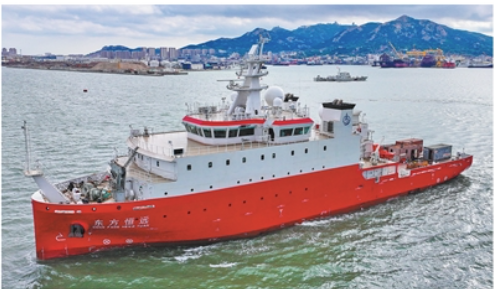
Dongfang Hengyuan — Maritime Space Launch Command and Tracking Vessel
Dongfang Hengyuan is China’s first maritime command and tracking vessel specifically designed to support the entire process of space launch missions at sea. The vessel is a high-end piece of offshore engineering equipment developed to provide command, tracking, measurement, and operational support for maritime space launches.
The photo shows Dongfang Hengyuan during its launching and sea-trial phase.
Photos: Li Rui and Li Xinjun
2. Expansion of Smart Ship Technologies
Intelligent ship technologies are moving from individual equipment applications toward the integration of multiple onboard systems.
In December 2025, the world’s first methanol dual-fuel intelligent very large crude carrier, Kaituo, was delivered. The vessel is equipped with several independently developed Chinese systems, including an intelligent ship platform, an intelligent liquid cargo management system, and an intelligent engine-room operation and maintenance system.
Across the wider industry, Chinese shipbuilders and technology providers have achieved progress in assisted autonomous navigation, integrated energy-efficiency management, machinery condition monitoring, ship–shore communications, and intelligent cargo management.
The integration of perception, decision-making, control, communications, and equipment management is enabling ships to operate more safely, efficiently, and autonomously. It is also supporting the development of predictive maintenance and lifecycle management for major ship systems.
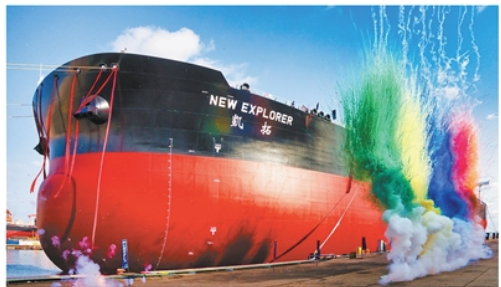
Kaituo — World’s First Methanol Dual-Fuel Intelligent Very Large Crude Carrier
Kaituo is the world’s first methanol dual-fuel intelligent very large crude carrier independently designed and built in China. It is equipped with domestically developed technologies, including an intelligent ship platform and an intelligent liquid cargo management and control system.
The photo was taken at the naming and delivery ceremony for Kaituo.
Photos: Liu Hongchao and Jiang Bingshang
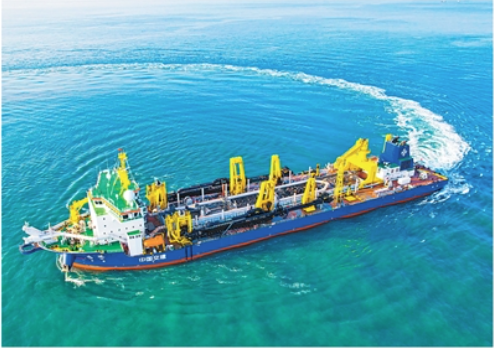
Tong Jun — Ultra-Large Trailing Suction Hopper Dredger
Tong Jun is an ultra-large trailing suction hopper dredger independently designed, developed, and built in China. The vessel is equipped with an advanced domestically developed intelligent dredging system that enables operators to identify and assess underwater soil conditions that were previously difficult to observe directly.
The photo shows Tong Jun undergoing sea trials.
Photo: Yao Chun/People’s Vision
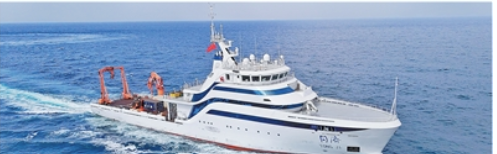
Tongji — Intelligent Ocean-Going Comprehensive Research Vessel
Tongji is China’s first ocean-going comprehensive research vessel to receive four intelligent ship class notations under the China Classification Society’s smart ship rules. Supported by high-speed communication networks and intelligent algorithms, the vessel can perform autonomous navigation in open waters, intelligent collision avoidance, and shore-based remote control.
The photo shows Tongji underway.
Photos: He Linping and Qiu Haijie
3. Acceleration of Green Ship Development
Green and low-carbon technologies have become another major direction for China’s shipbuilding industry.
Progress has been made in the research and development of several new environmentally friendly ship types, including 192,000-cubic-metre LNG carriers with Type-B cargo tanks and electric propulsion, 20,000-cubic-metre liquefied hydrogen carriers, and 300,000-dwt ammonia dual-fuel very large crude carriers.
In 2025, China accounted for 69.2% of the international market for newly placed green ship orders. This indicates that alternative-fuel vessels, energy-efficient ship designs, and low-emission propulsion technologies are becoming increasingly important to the international competitiveness of China’s shipbuilding sector.
The development of LNG, methanol, ammonia, hydrogen, electric propulsion, and other emerging energy solutions is also encouraging closer cooperation among shipyards, shipowners, equipment suppliers, classification societies, research institutions, and fuel producers.
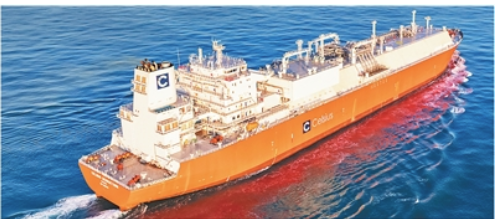
Celsius Georgetown — China’s First 180,000-cubic-metre LNG Carrier
Celsius Georgetown is China’s first 180,000-cubic-metre liquefied natural gas carrier and the largest LNG carrier completed in the country to date. Its construction represents a major breakthrough for Chinese shipbuilders in the development and construction of large clean-energy transport vessels.
The photo shows Celsius Georgetown during sea trials.
Photos: Yao Xueqing and Xu Guoyan
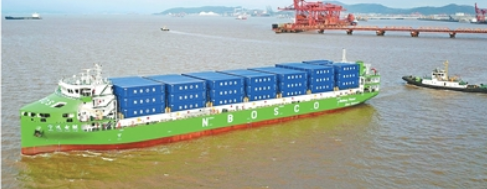
Ningyuan Dian Kun — World’s Largest Pure-Electric Intelligent Seagoing Container Ship
Ningyuan Dian Kun is the world’s largest and China’s first 10,000-tonne-class pure-electric intelligent seagoing container ship. It is powered by ten standardized containerized battery units with a combined energy-storage capacity of approximately 20,000 kilowatt-hours, enabling zero-emission, low-noise, and pollution-free operation.
Once in service, the vessel is expected to save approximately 580 tonnes of fuel and reduce carbon dioxide emissions by more than 1,400 tonnes annually.
The photo shows Ningyuan Dian Kun departing from the Beilun port area of Ningbo-Zhoushan Port.
Photo: Xinhua
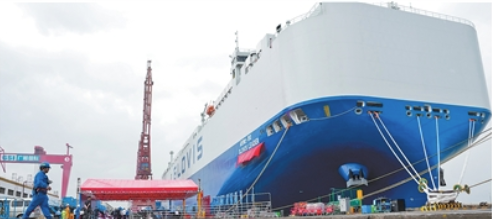
GLOVIS LEADER — World’s Largest Vehicle Carrier
Built independently by a Chinese shipbuilding enterprise, GLOVIS LEADER is the world’s largest vehicle carrier. The vessel can generate electricity while sailing and incorporates multiple energy-saving and emission-reduction technologies.
The photo shows the newly delivered GLOVIS LEADER.
Photo: Wu Lu/Xinhua
4. Moving toward the Deep Blue
China’s shipbuilding industry is entering a new stage characterized not only by production scale, but also by technological sophistication, intelligent systems, green development, and stronger industrial coordination.
By strengthening its core capabilities and responding to emerging opportunities in the global maritime market, China is expected to continue expanding its role in advanced commercial shipbuilding, marine engineering equipment, smart shipping, and sustainable maritime transportation.
The continued delivery of high-end vessels and the development of new technologies will provide important support for global maritime trade and the sustainable development of the ocean economy.
Original Title: China’s Ships Are Advancing toward Farther and Deeper Seas
Source: People’s Daily
Reproduced and adapted for ICNAME