
Harbin Engineering University Develops Fast Underwater Image Enhancement Method for Deep-Sea Equipment
A research team led by Professor Qin Hongde at the College of Shipbuilding Engineering, Harbin Engineering University, has achieved a major breakthrough in underwater image enhancement. The study, entitled Diffusion-Based Frequency Degradation Prior Fusion with Hierarchical Wavelet Decompositions for Underwater Image Enhancement, has been published in Information Fusion. Doctoral student Chen Haojie is the first author, and Professor Wang Zhuo is the corresponding author.
Underwater images often suffer from severe colour distortion, low contrast and blurred details because of light absorption and scattering in seawater. These degradations significantly affect visual tasks such as underwater target detection, three-dimensional reconstruction, emergency rescue and infrastructure inspection. Although diffusion models have demonstrated strong enhancement performance, their high computational cost, numerous iterative steps and slow inference speed make them difficult to deploy on embedded systems carried by underwater robots.
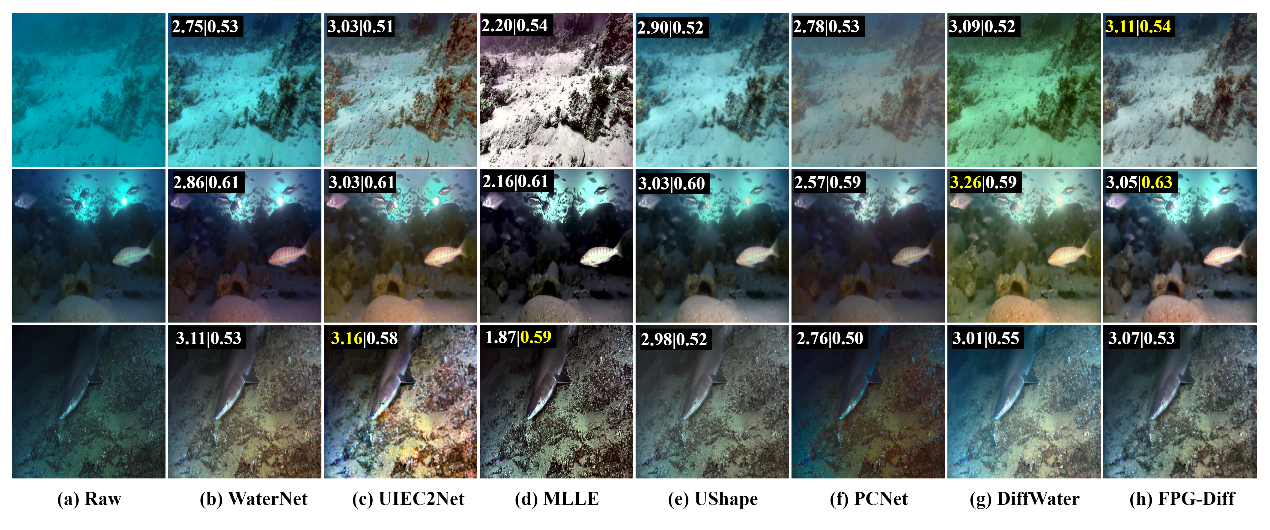
To address this challenge, the team proposed a new underwater image enhancement framework named FPG-Diff. Rather than directly generating enhanced images through a conventional diffusion model, the method separates degradation modelling from image restoration. A frequency-domain diffusion model is used to extract prior information describing underwater imaging degradation, while hierarchical wavelet decomposition separates high- and low-frequency image features. Multi-scale convolution and self-attention modules then restore texture details, with the degradation priors dynamically guiding the correction of colour and contrast.
Tests on public benchmark datasets showed that FPG-Diff outperformed mainstream underwater image enhancement methods in terms of PSNR, SSIM and perceptual image quality. The method maintained strong robustness under challenging conditions such as low illumination and heavy turbidity. It requires only five diffusion iterations and achieves an inference speed more than 200 times faster than comparable diffusion-based approaches, making it highly suitable for lightweight and real-time embedded applications.
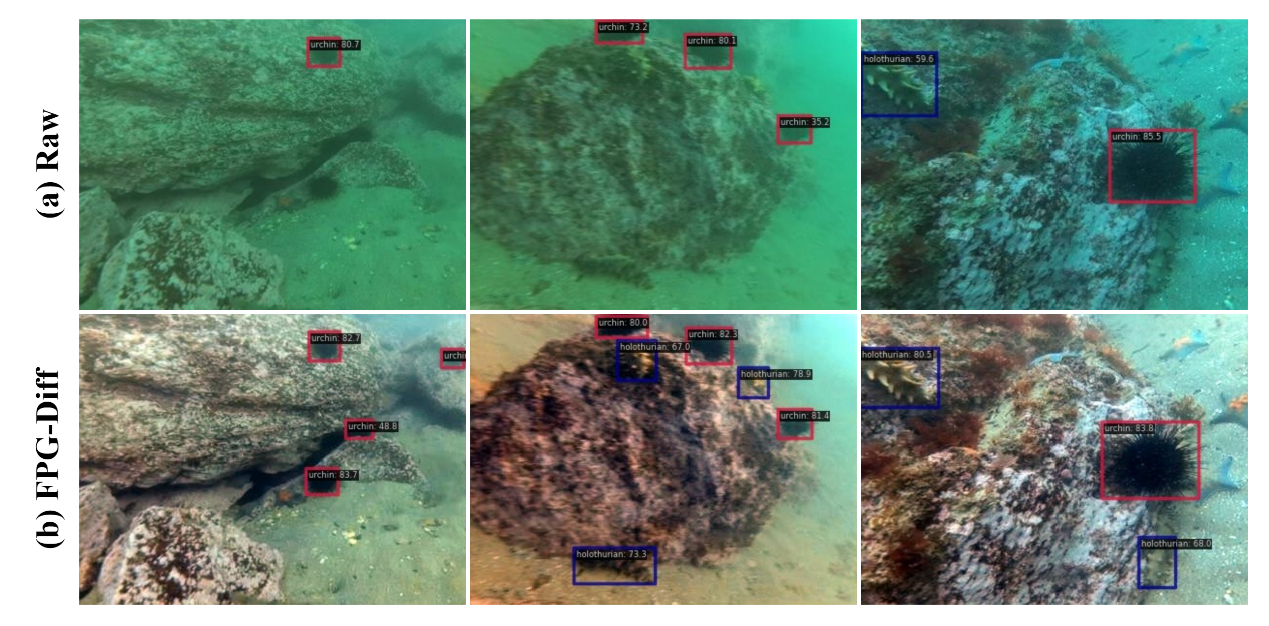
The new method can significantly improve the visual perception capabilities of underwater equipment and support applications including autonomous underwater vehicle detection, underwater emergency response and subsea facility inspection. The research provides a promising technical solution for intelligent underwater visual perception in future ocean engineering systems.
Information Fusion is a leading international journal in artificial intelligence, focusing on multimodal information fusion, intelligent perception and distributed sensing, with a latest impact factor of 17.4.