
HEU Study on the Two-Stage Mechanism of Bubble-Jet Formation Featured on the Cover of Journal of Fluid Mechanics
A research team from the College of Shipbuilding Engineering at Harbin Engineering University (HEU) has recently achieved an important breakthrough in bubble dynamics. Their paper, entitled “Jet Formation in Air Bubbles Induced by Cavitation Bubbles,” has been selected as the cover article of the Journal of Fluid Mechanics (JFM), a leading international journal in fluid mechanics.
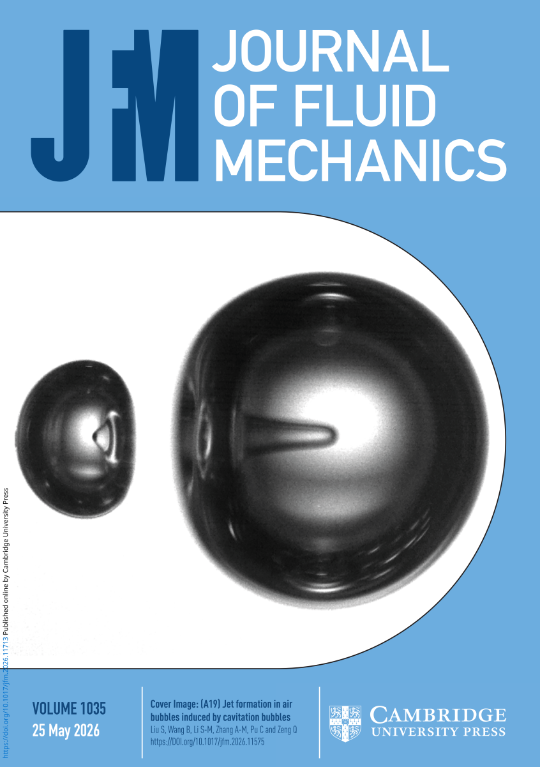
The paper was co-first-authored by doctoral student Shiyu Liu and master’s student Bingqi Wang from the College of Shipbuilding Engineering, with Professor Qingyun Zeng serving as the corresponding author.
Transient liquid jets are widely observed in both natural phenomena and engineering applications, including bubble bursting, droplet impact on liquid surfaces, and laser-induced cavitation. Previous studies have primarily focused on interactions between two cavitation bubbles, showing that high-speed jets can be generated only under highly restrictive conditions involving extremely small bubble separations and precise phase matching.
However, the interaction between air bubbles and cavitation bubbles—a more common phenomenon in natural and industrial multiphase flows—has long lacked a systematic physical explanation. By combining theoretical analysis, high-resolution experiments, and high-fidelity numerical simulations, the HEU research team revealed the complete physical process through which a jet forms inside an air bubble driven by a nearby cavitation bubble.
Three Distinct Jetting Regimes
The researchers found that three fundamentally different jetting regimes can arise depending on the relative distance between the cavitation bubble and the air bubble, as well as their size ratio:
1. weak jets;
2. strong jets; and
3. explosive jets.
Rather than being produced through a single process, the jets undergo two clearly distinguishable acceleration stages.
First, the shock wave generated by the collapse of the cavitation bubble imparts an initial velocity to the air–liquid interface. Subsequently, the liquid flow is focused along the curved bubble interface, producing a second acceleration of the jet.
This two-stage mechanism—comprising shock-wave initiation followed by flow-focusing amplification—successfully explains the physical origin of the observed high-speed jets.
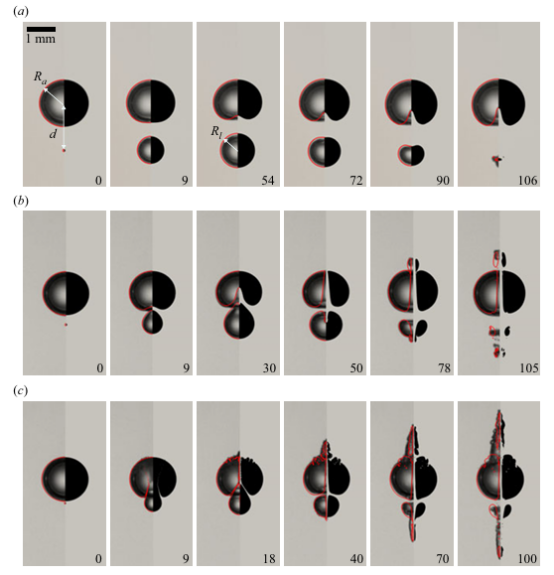
Comparison between experiments (left) and simulations (right) for the three jetting regimes: (a) weak jet; (b) strong jet; and (c) explosive jet.
Parameter-Free Scaling Laws and a Predictive Regime Map
The research team derived closed-form, parameter-free velocity scaling laws for each of the two acceleration stages. The jet velocities predicted by the theoretical models showed excellent agreement with both experimental measurements and numerical simulation results.
On this basis, the researchers constructed a parameter-space regime map using the bubble separation ratio and size ratio. The map accurately identifies the regions occupied by the three jetting regimes and their transition boundaries.
The boundary for explosive jets was derived from the condition for liquid-film rupture, while the transition between strong and weak jets was determined by whether the kinetic energy of the jet was sufficient to overcome surface tension. These theoretical boundaries accurately predicted abrupt transitions in jet morphology under different operating conditions.
A Stable Platform for Controllable Jet Generation
A key innovation of the study is its demonstration that an air bubble can serve as a stable curved interface for generating controllable liquid jets when coupled with a cavitation bubble.
Compared with cavitation-bubble pairs, whose jetting behaviour is extremely sensitive to bubble phase, the air-bubble–cavitation-bubble configuration provides a more stable and fault-tolerant engineering platform for jet generation.
The findings not only deepen the understanding of bubble-interaction dynamics in multiphase flows, but also provide direct theoretical guidance and a practical design map for controlling jet velocity, jetting regime, and impact effects.
The research has broad potential applications in areas including cavitation-erosion protection for underwater equipment, cavitating flows around marine vehicles, underwater micro-actuation and robotics, microfluidics, and bioprinting.
Founded in 1956 by renowned fluid dynamicist George K. Batchelor, the Journal of Fluid Mechanics is published by Cambridge University Press and is internationally recognised as a leading journal in the field of fluid mechanics. The journal currently has an impact factor of 3.9.
Original article:
https://doi.org/10.1017/jfm.2026.11575